1. Claude Is Now a Colleague in Slack
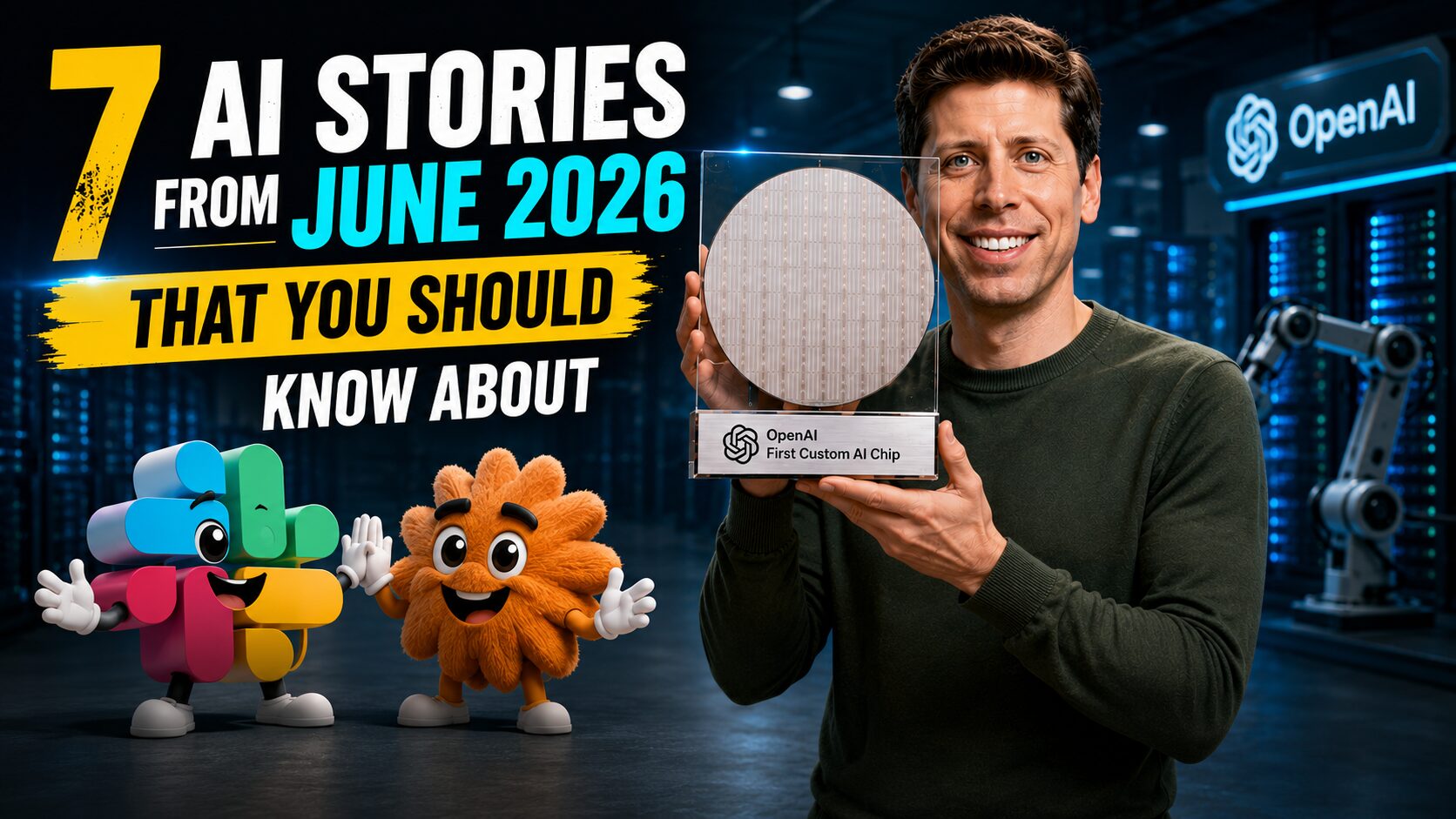
Anthropic launched Claude Tag on June 24, bringing agentic AI directly into Slack. Teams can tag Claude like a colleague, assign it a task, and it works through it asynchronously using approved tools and data. It builds context about the work being done across channels over time and even follows up on tasks that have gone quiet.
Andrej Karpathy described it as the third major redesign of AI user experience: from chat interface, to desktop app, to Slack, where most business context actually lives. For teams that have been waiting for AI to fit into existing workflows rather than requiring new ones, this is a meaningful shift. Several agentic AI startups built around this exact premise are feeling the impact today.
2. OpenAI Built Its First Custom Chip
OpenAI unveiled its first custom AI chip, built in partnership with Broadcom. Until now, OpenAI has been entirely dependent on Nvidia for compute powering its models.

3. AI Is Not Killing Engineering Jobs. It Is Making Them More Resilient.
New data published this week challenges one of the most widely repeated assumptions about AI and the workforce. Engineering roles are proving to be among the most resilient in the economy despite AI's rapid capability growth.
The dominant narrative has been that technical roles face the highest displacement risk as AI learns to write code. These data points in the opposite direction. The skills that make engineers valuable are evolving alongside the tools rather than being replaced by them. For any professional wondering whether investing in technical skills still makes sense in an AI-augmented world, this is a meaningful data point.
4. A Free Open-Weights Model Is Now Competing With Frontier AI
Chinese AI lab Z AI released GLM-5.2 this month under an MIT licence. The model is competitive with GPT-5.5 and Claude Opus 4.8 on coding benchmarks, carries a one million token context window, and costs a fraction of what closed models charge per token.
This is a significant threshold. For the first time, a freely available model is genuinely competitive with the best closed systems on meaningful benchmarks. Any company currently paying enterprise rates for frontier AI access now has a credible free alternative to evaluate. The calculus around AI spend is changing faster than most procurement decisions can keep up with.
5. 100 Security Experts Are Pushing Back Against the Fable Ban
Earlier this month, the US government's export control order forced Anthropic to take down its Fable 5 model. Over 100 cybersecurity executives and researchers responded by signing an open letter arguing that the ban handcuffs defenders without slowing attackers, since the same capabilities exist across GPT-5.5, Kimi 2.7, Opus, and Sonnet. Signatories include security leaders from Adobe, Zoom, Nvidia, and Stanford HAI.
The practical implication for any business building on AI tools is straightforward: government regulation of specific models is now a real operational risk. A model that is central to your workflow can be taken offline by a regulatory order with little warning. The Fable situation is the first high-profile example of this, and it will not be the last. How dependent any given business is on a single model is now a risk management question, not just a procurement one.
6. Microsoft's Nadella: Your AI Edge Is Not the Model You Use
Satya Nadella published a memo this month that reframes the entire question of AI competitive advantage. His argument: a company's real edge does not come from using the best available model. It comes from building a learning loop of its own workflows, judgment, and institutional knowledge into AI systems over time.
His test is deliberately simple. Remove one model, drop in a different one, and your company's accumulated knowledge should stay put. If it disappears with the model, you have not built anything. You have just been renting someone else's intelligence.
For any business evaluating AI investment, this shifts the question from "which model should we use" to "how do we make sure our knowledge survives the next model switch?" That is a fundamentally different and more durable strategy.
7. Harvard Found AI Makes Learning Better When Used the Right Way
Harvard researchers found that AI significantly improves learning outcomes when used as an active learning partner rather than a simple answer machine. The distinction matters more than most people realise.
Most professionals using AI are using it as an answer machine: ask a question, accept the output, move on. This research confirms that engaging with AI to challenge your thinking, test your assumptions, and build your own understanding produces measurably better outcomes. The same tool used differently produces a fundamentally different result.
For anyone using AI for professional development, team training, or upskilling, this is the most directly actionable finding in this list. The question is not whether to use AI for learning. It is whether you are using it in a way that actually builds capability or just delivers answers.
Conclusion
Seven stories. One consistent signal. AI is embedding itself into the daily infrastructure of professional work at a pace that is outrunning most people's ability to track it. Claude is in Slack. OpenAI is building its own hardware. A free model now matches the frontier. A government can take down a model overnight. And the way most people use AI for learning is the wrong way.
If you want insights like these in your inbox every week, subscribe to the Awesome Analytics newsletter.