Introduction
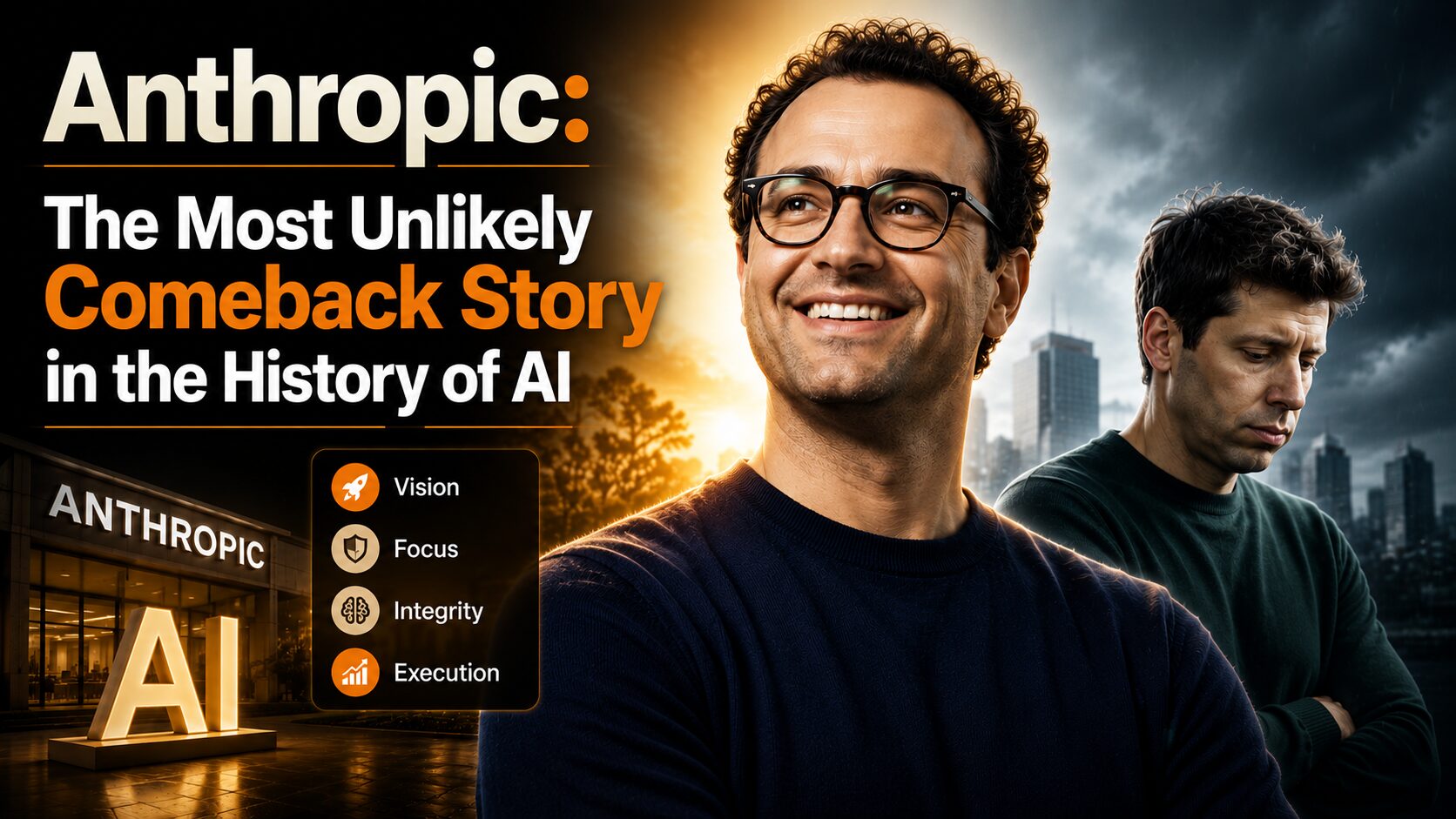
Dario Amodei and six colleagues left OpenAI in 2020 with no model, no compute, no customers, and no infrastructure. What drove them out was not ambition. It was fear. Anthropic's own founding statement captures it plainly: "We founded Anthropic because we believe the impact of AI might be comparable to that of the industrial and scientific revolutions, but we aren't confident it will go well." That fear became the strategy.
The Fear That Started Everything
While at OpenAI, Dario observed something called scaling laws.
As AI models were given more data, larger architectures, and more compute, they did not improve linearly. They improved exponentially. Every increase in resources produced disproportionately smarter AI, consistently across writing, reasoning, mathematics, and code. Nobody could say where that curve stopped.
In May 2023, the Center for AI Safety published a statement signed by Sam Altman, Dario Amodei, and Geoffrey Hinton, the scientist credited with founding modern deep learning: "Mitigating the risk of extinction from AI should be a global priority alongside pandemics and nuclear war."
Dario's response was not to stop building AI. It was to conclude that if this technology was coming regardless, the most responsible position was to be among those building it as carefully as possible.
Building Differently: Structure Over Speed
While every other AI company optimised for speed, Anthropic built its structure around a different priority.
Anthropic was incorporated as a Public Benefit Corporation, legally permitted to prioritise its mission over shareholder returns. They reinforced this with the Long-Term Benefit Trust, five independent trustees with no equity, no salary, and no financial stake in Anthropic, whose role is to hold the company to its safety mission regardless of commercial cost. This structure was referenced in Anthropic's $4 billion investment agreement with Amazon in September 2023.
They also introduced the Responsible Scaling Policy: a self-imposed requirement to conduct internal safety tests before deploying any new model. Not standard industry practice. A deliberate constraint that trades deployment speed for enterprise trust.
The Technical Differentiation: Constitutional AI
The industry's standard safety approach, Reinforcement Learning from Human Feedback (RLHF), relies on human raters ranking AI responses. It is expensive, slow, transfers human bias into the model, and breaks down when AI solves problems no human can meaningfully evaluate.
Anthropic published an alternative in December 2022: Constitutional AI. Instead of human raters, the AI is given a written constitution and trained to critique and rewrite its own responses against those principles using AI-generated feedback. The values are transparent, scalable, and adjustable.
Claude's Constitution has been publicly available since May 2023 and was updated as recently as January 2026. For enterprises evaluating whether to trust an AI with sensitive operations, a readable and regularly revised governance document is a meaningful differentiator.
The Business Model: Enterprise Over Consumer
OpenAI built for everyone. Anthropic built for businesses.
ChatGPT became the fastest consumer product in history to reach 100 million users but the majority pay nothing and every free conversation costs real compute money. Fame and revenue are not the same thing.
Anthropic focused on what enterprises actually pay for: long document processing, reliable code, and consistent performance in high-stakes environments. When Amazon invested up to $4 billion in 2023, enterprises were already building on Claude. LexisNexis for legal search and drafting. Bridgewater Associates for investment analysis. Lonely Planet reducing itinerary generation costs by approximately 80%.
Claude 3 briefly outperformed GPT-4 on standard benchmarks. Claude 3.5 Sonnet became the leading coding model among developers. Claude 4 and Claude Code accelerated both adoption and revenue, with run rate reportedly growing from $1 billion at end of 2024 to $47 billion by early 2026. An enterprise that builds its core product on an AI platform does not switch easily. That durability is what makes enterprise revenue fundamentally different from consumer subscriptions.
Conclusion
The Anthropic story is about a bet the entire industry thought was the wrong priority: that in a technology race defined by speed, the company that built around trust would win the customers that mattered most.